
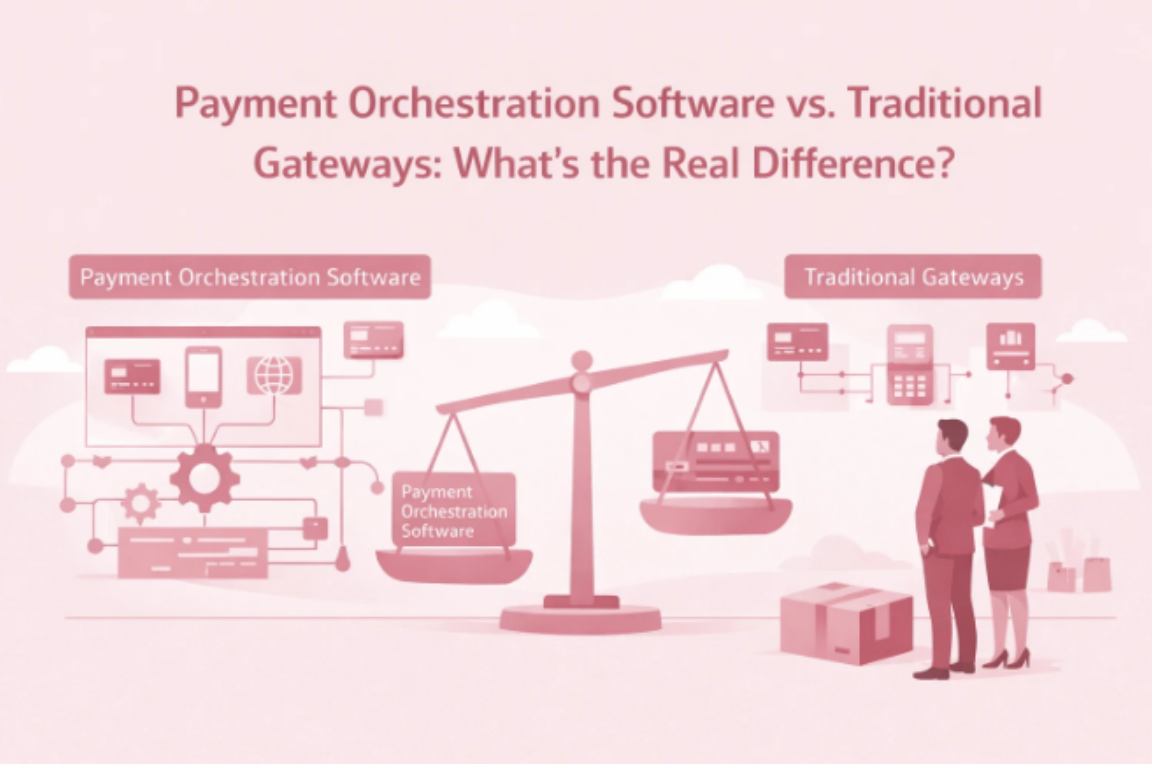
For years, businesses relied on a single payment gateway to handle their transactions — and for a long time, that was enough. But as commerce went global, customer expectations evolved, and payment ecosystems grew increasingly complex, the limitations of traditional gateways became impossible to ignore. Today, a growing number of merchants, PSPs, and financial platforms are making the switch to payment orchestration software — a fundamentally different approach to managing payments that puts flexibility, performance, and control at the center of every transaction. Understanding what separates these two models isn’t just a technical exercise; it’s a strategic decision that directly impacts your revenue, your customer experience, and your ability to scale.
What Traditional Payment Gateways Actually Do — and Where They Fall Short
A traditional payment gateway acts as the bridge between a merchant’s checkout and the acquiring bank or card network. It encrypts card data, sends authorization requests, and relays approval or decline messages back to the merchant. For a small business processing payments in a single country, this setup works reasonably well. The integration is straightforward, the pricing is predictable, and there’s a certain comfort in simplicity.
But simplicity comes at a cost. Traditional gateways are, by design, single-provider solutions. If your gateway goes down, your payments go down. If the gateway doesn’t support a particular local payment method in a new market you’re entering, you either find a workaround or lose the sale. If your approval rates are suffering because the gateway routes every transaction through the same acquirer regardless of card type, geography, or transaction size — there’s very little you can do about it from the inside.
The deeper problem is control, or rather, the lack of it. With a traditional gateway, the routing logic, the fraud rules, the supported currencies, and the settlement flows are largely determined by the provider. Merchants adapt to the gateway’s capabilities rather than the other way around. For businesses with simple, domestic transaction flows, this trade-off is acceptable. But for companies operating across multiple regions, processing high volumes, or working with a diverse customer base, the rigidity of traditional gateways becomes a genuine bottleneck.
There’s also the question of data. Traditional gateways provide reporting — transaction logs, settlement summaries, basic decline reasons — but rarely the depth of insight needed to actively optimize payment performance. You can see what happened, but you can’t easily change what happens next.
How Payment Orchestration Changes the Equation
Payment orchestration operates on an entirely different premise. Instead of connecting a business to a single provider, a payment orchestration platform sits as an intelligent layer above multiple gateways, acquirers, banks, and alternative payment methods — routing, managing, and optimizing every transaction in real time based on rules that the business itself defines.
The scale of connectivity alone represents a meaningful shift. A platform like Akurateco offers access to 600+ payment integrations with banks, acquirers, APMs, and local providers worldwide through a single integration point. This means a merchant can accept payments in local and international currencies using the most relevant methods in each market — without building and maintaining dozens of separate integrations.
But connectivity is just the foundation. The real value of payment orchestration lies in what happens to each transaction once it enters the system. Intelligent routing engines automatically direct payments to the best-performing provider based on parameters like cost, geographic region, card type, or historical approval rates. This isn’t static configuration — it’s dynamic decision-making that responds to real-time performance data. The result is measurable: businesses using Akurateco’s orchestration platform report approval rate increases of up to 30%, alongside reductions in processing costs of up to 30% through optimized transaction flows.
When a transaction is declined, cascading kicks in automatically — rerouting the payment through an alternative provider within the same transaction attempt. From the customer’s perspective, nothing changes. From the merchant’s perspective, a potential lost sale becomes a completed order. This combination of intelligent routing and instant cascading is something a traditional gateway simply cannot replicate, because it only has one path to offer.
Security, Tokenization, and Fraud Prevention at Scale
One area where the gap between traditional gateways and payment orchestration platforms becomes especially clear is in security and fraud management. Traditional gateways offer fraud screening — typically rule-based filters that flag suspicious transactions — but these systems are usually limited in their customizability and scope. Merchants often find themselves adjusting a handful of parameters within a system they don’t fully control, hoping it strikes the right balance between security and conversion.
Payment orchestration platforms approach fraud prevention with considerably more sophistication. Akurateco’s fraud engine, built on 50+ years of combined expertise, monitors transactions using over 150 customizable fraud filters that adapt to evolving threat patterns in real time. The system doesn’t just apply static rules — it learns from transaction data and adjusts to new fraud vectors as they emerge. For businesses processing high volumes across multiple geographies, this kind of adaptive protection is essential. The measurable impact speaks for itself: fraud reduction of up to 28%, alongside a 3% boost in authorization rates from card data protection at the network level.
Tokenization is another dimension where orchestration pulls ahead. Rather than relying on a single provider’s tokenization scheme, orchestration platforms maintain a centralized token vault that works across all connected providers. This means that when a card is reissued, automatic card updates keep recurring payment flows intact without requiring customers to re-enter their details. For subscription businesses or any model that depends on stored payment credentials, this is a significant operational advantage. Seamless recurring payments, tokenized Apple Pay and Google Pay support, and Pay by Link functionality all become accessible through a single platform — without the need to negotiate each feature separately with a gateway provider.
Reconciliation is another operational challenge that orchestration addresses head-on. Managing settlement data across multiple providers is a manual, error-prone process when done through separate gateway portals. Orchestration platforms automate this: transactions are matched across providers, settlement tracking is streamlined, and the back office stays current without the manual overhead that grows proportionally with transaction volume.
Choosing the Right Model for Your Business
The decision between a traditional gateway and a payment orchestration platform isn’t simply about feature lists — it’s about where your business is headed and what you need payments infrastructure to do for you. For early-stage businesses with modest transaction volumes, a single domestic customer base, and straightforward payment needs, a traditional gateway may still be the appropriate starting point. It’s simpler to implement, easier to manage, and sufficient for the use case.
But for businesses that are scaling, expanding internationally, managing high-risk verticals, operating as PSPs or payment facilitators, or simply looking to maximize the revenue impact of their payment stack, the calculus shifts decisively toward orchestration. The best payment orchestration platforms offer not just technical infrastructure but a strategic advantage — the ability to treat payments as a lever for growth rather than a cost center to be managed.
Akurateco exemplifies this approach with a platform designed around measurable business outcomes. With three deployment options — SaaS, On-Premise, and Cloud-Agnostic — businesses can implement the model that fits their infrastructure and compliance requirements. Implementation timelines are compressed: payment processing can be operational in as few as five days, with new integrations developed and launched within 14 days. Uptime SLA of 99.95% ensures that payment operations remain uninterrupted as transaction volumes grow. And with support for 200+ currencies and cryptocurrencies alongside dedicated account management, merchants gain both the technical breadth and the operational support to optimize performance continuously.
The shift from traditional gateways to payment orchestration reflects a broader maturation in how businesses think about payments. A gateway processes transactions. An orchestration platform manages them — actively, intelligently, and in alignment with business goals. As global commerce continues to grow in complexity, the difference between those two approaches will only become more consequential.