
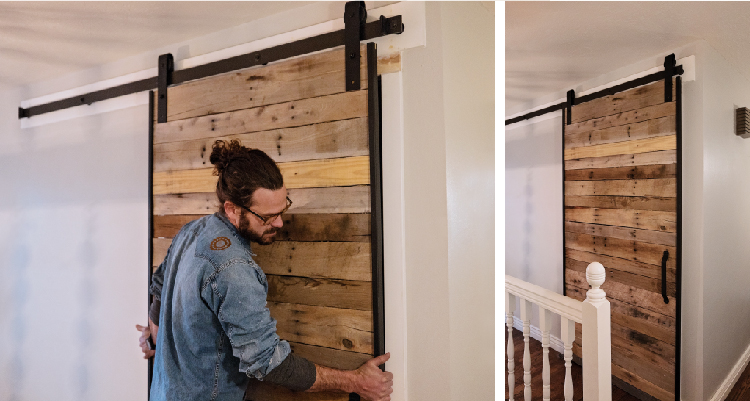
Sliding barn door hardware sits in an interesting middle ground for DIY projects. It’s not wiring or plumbing, where a mistake carries real safety consequences. But it’s also not hanging a shelf, where the worst outcome is a slight lean. Get a barn door installation wrong and you end up with a 60-pound door that wobbles, jumps the track, or gradually pulls itself away from the wall. The question of whether to DIY or hire a professional isn’t really about skill level in the abstract. It’s about whether your specific situation has the variables that make DIY straightforward, or the ones that make it genuinely complicated.
This guide is honest about both sides of that question, which means it won’t just tell you it’s easy and send you off to the hardware store.
What Makes Sliding Barn Door Hardware DIY-Friendly
The core installation process isn’t complicated. A sliding barn door runs on a track mounted above the door opening, with rollers that attach to the door and ride the track. The structural requirements are real but not exotic: solid mounting points into studs, a track that’s properly level, and hardware that’s rated for the weight of the door. None of that requires specialist knowledge or specialist tools.
Most people with basic DIY experience, a drill, a level, and a willingness to read the instructions carefully can install sliding barn door hardware on a standard interior wall. The kits sold at home improvement stores and online are designed with this in mind. The instructions are detailed, the components are pre-cut, and the adjustment range built into most roller hardware gives you some tolerance for imperfection.
If your situation looks like this: a standard interior wall with drywall over stud framing, a door opening with reasonable clearance on one side, and a door that’s a normal residential weight, you can probably handle the installation yourself. A lot of people do.
What Makes It Worth Calling a Pro
The scenarios where DIY gets tricky are fairly specific, but they come up more often than the sales-friendly guides acknowledge.
No Studs Where You Need Them
This is the most common complication. Sliding barn door hardware needs to be anchored into structural framing, not just drywall. The track goes above the door opening and needs mounting points on either side that hit solid wood. In a standard stud-framed wall, studs are typically 16 inches apart, and there’s usually one close enough to each side of a standard door opening to work with.
But “usually” isn’t “always.” Walls around door openings sometimes have irregular framing, especially in older homes. A header board can solve this, but cutting, finishing, and mounting a proper header board adds complexity, and a header board that isn’t itself well-anchored doesn’t solve the problem.
If you probe the wall above your door opening and find drywall without stud backing at the points where the track needs to mount, that’s a situation where a professional who knows how to open a wall, add blocking, and close it back up is going to produce a better result than improvised anchor solutions.
Masonry or Tile Walls
A barn door on a brick wall, a concrete wall, or a wall with tile above the opening is a different installation entirely. It requires masonry anchors, a different drilling approach, and a level of confidence with those tools that not everyone has. Mistakes in masonry are harder to hide and harder to reverse than mistakes in drywall.
This isn’t to say it can’t be done as a DIY project. It can. But it’s a categorically different job from a standard drywall installation, and if you’ve never drilled into masonry before, a sliding barn door isn’t the project to learn on.
Very Heavy Doors
Weight is the variable most people underestimate. A solid hardwood door at standard residential dimensions can weigh 60 to 80 pounds. At that weight, handling the door safely during installation genuinely requires two people, and the hardware selection, wall anchoring, and track specification need to be matched to that weight with some care.
If you’re working with a reclaimed wood door, a door with decorative ironwork, or anything else that pushes into the upper weight ranges, it’s worth having a professional assess the wall structure and hardware requirements before proceeding. The cost of that assessment is considerably less than the cost of a track that fails under load.
The Tools Question
A basic sliding barn door installation requires a drill, a level, a stud finder, a measuring tape, and some patience. Most people have all of these or can borrow them.
What separates a good installation from a mediocre one is usually the level, specifically how carefully it’s used. A track that’s 1/8 inch out of level across its length will cause the door to drift toward the low end when open. That might sound minor, but a door that slowly swings open on its own is annoying enough that people end up living with a doorstop to keep it in place, which is a permanent reminder of an avoidable mistake.
A laser level is worth using if you have access to one, particularly on tracks longer than about 48 inches. The accuracy improvement over a spirit level on a longer track is real, and the cost of renting one for a day is minimal compared to the labor of redoing the installation.
What a Professional Brings That’s Hard to Quantify
The practical case for hiring a professional isn’t just about technical complexity. It’s about what happens when something unexpected comes up mid-installation.
When a professional opens the wall to check framing and finds that the previous owner had done some creative remodeling that left an inconsistent stud layout, they know what to do. When the door is heavier than anticipated and the specified hardware is borderline for the load, they recognize it and make the call to upgrade before the track goes up. These are judgment calls that come from having installed a lot of sliding barn door hardware in a lot of different conditions, and that experience is genuinely worth something.
It’s also worth acknowledging that a professional installation typically comes with some form of warranty on the work. If the track pulls away from the wall in year two, that’s their problem to fix, not yours.
What to Budget For Either Option
For a standard DIY installation on a single interior door, the hardware itself runs roughly $80 to $250 depending on quality, style, and whether the kit includes a door or just the hardware. Add $20 to $50 for fasteners, a header board if needed, and any tools you don’t already own. Total material cost for a basic installation is usually under $300.
Professional installation charges vary significantly by region, but a straightforward interior barn door installation typically runs $150 to $400 in labor, on top of the hardware cost. For a complicated installation, expect more.
The calculation shifts based on how much you value your time, how confident you are with the physical process, and what your walls are actually made of. If a DIY installation goes well, you save the labor cost and get the satisfaction of having done it yourself. If it goes poorly, you pay to have someone fix it, which usually costs more than hiring a professional from the start.
A Few Things Worth Checking Before Deciding
Before committing to either path, it’s worth spending twenty minutes on some basic reconnaissance.
Use a stud finder to map the framing above your door opening. Mark where the studs are, note how far they fall from each side of the opening, and check whether there’s solid backing where the track ends will need to mount. This one step tells you a lot about how straightforward the installation is going to be.
Check the clearance on the wall beside the door opening. The track needs to extend past the opening by at least the full width of the door, so the door can slide completely clear. If there’s a light switch, a corner, or another door within that distance, the layout gets complicated. A contractor can solve these problems with a bypass system or a custom track configuration, but they’re not straightforward DIY territory.
Weigh the door if you can, or look up the specification for the door model if it’s a new purchase. Hardware rated for 50 pounds shouldn’t be used on a 70-pound door regardless of how good the rest of the installation is.
None of this is intended to be discouraging. Sliding barn door hardware is genuinely one of the more approachable home improvement projects when the conditions are right. It just helps to know what the conditions actually are before choosing your approach.